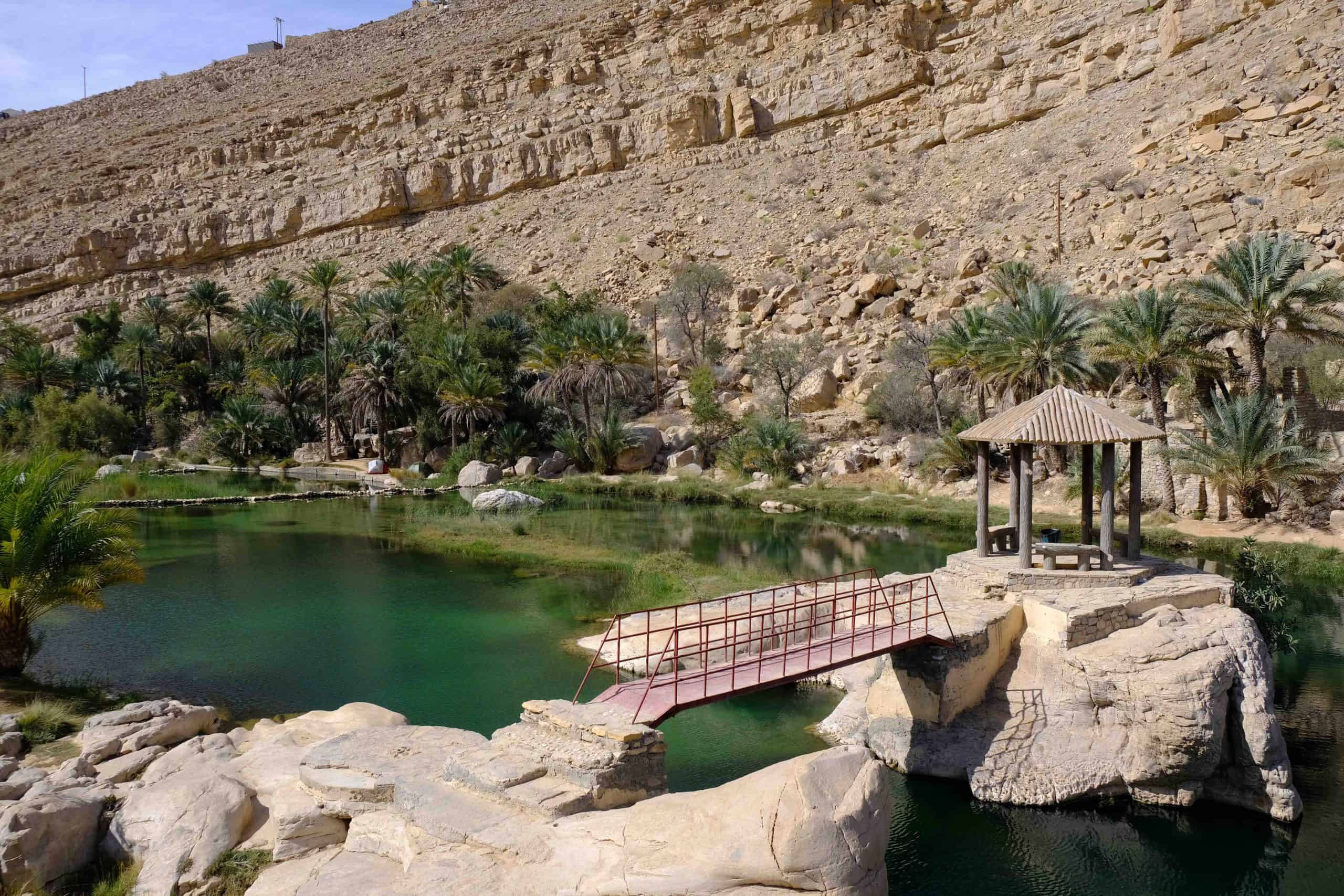
Imagine driving through Oman's rugged mountain landscape, surrounded by sunlit rocks and dry valleys, when suddenly the scenery changes. Date palms appear between the cliffs, and beyond them lies a beautiful stretch of emerald-green water.
This is Wadi Bani Khalid, one of Oman's most remarkable natural attractions.
But the real reason to visit isn't simply to take a photograph of its turquoise pools. It's the opportunity to experience a completely different side of Oman: swim in freshwater, wander through a dramatic rocky valley, discover the landscape around a traditional Omani village, and even combine the experience with an adventure across the golden dunes of Wahiba Sands.
If you're planning to visit Wadi Bani Khalid in Oman, this guide answers the questions that matter before you travel: where it is, how to get there from Muscat, where you can swim, the best time to visit, what to bring, and whether booking a guided tour is worthwhile.
And if you're wondering whether you can experience both Oman's desert and its famous natural pools in one day, the answer may surprise you.
What Is Wadi Bani Khalid in Oman?
Wadi Bani Khalid is a year-round freshwater valley in North Ash Sharqiyah, Oman, known for its turquoise natural pools, limestone cliffs, date palm groves, and nearby Muqal Cave. It is a popular destination for swimming, sightseeing, nature photography, and day trips from Muscat.
Unlike many seasonal waterways, Wadi Bani Khalid has a reliable natural water supply. This gives the valley its distinctive green appearance even when the surrounding landscape is dry.
The destination offers something for several types of travelers. Families can enjoy the main pool area and scenery, photographers can explore beautiful contrasts between water and rock, and more adventurous visitors can follow the rocky canyon paths where conditions permit.
It is also conveniently located for travelers exploring the Sharqiyah region, particularly those planning to visit the nearby Wahiba Sands desert.
Wadi Bani Khalid at a Glance
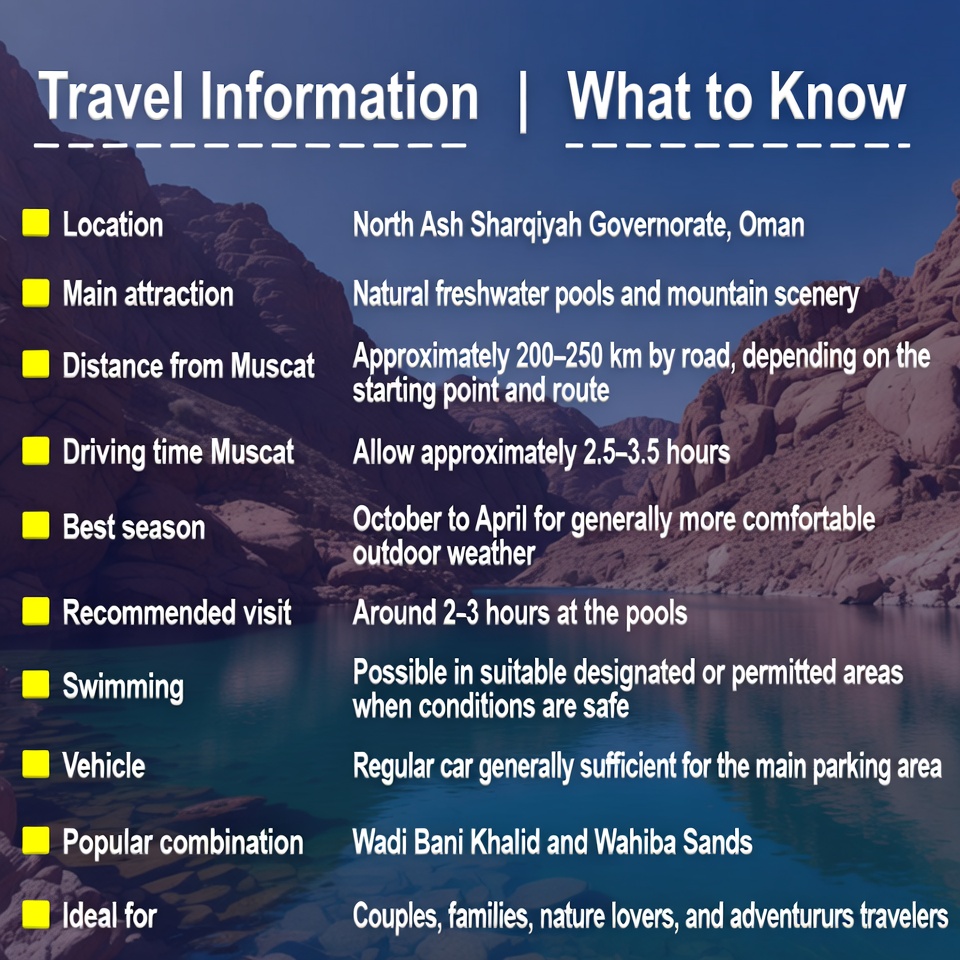
Travel times are estimates. Weather, road conditions, local access arrangements, and swimming conditions can change.
Why Is Wadi Bani Khalid One of the Best Places to Visit in Oman?
Oman has extraordinary landscapes, from the coastline of Muscat to the mountains of Jebel Shams and the immense dunes of Sharqiyah Sands.
Yet Wadi Bani Khalid offers a particular kind of experience: a natural oasis surrounded by an otherwise arid landscape.
The contrast is what makes it memorable.
At first, the scenery feels almost entirely rocky. Then you reach a valley where palms grow beside clear water and the mountain walls frame beautiful natural pools.
And unlike more demanding outdoor attractions, you don't necessarily need to undertake a long hike to appreciate the scenery.
The main pools are reached by a relatively short walk from the parking area, allowing visitors with different interests and fitness levels to enjoy the destination. The ground can still be uneven and slippery, and the site should not be considered fully accessible for everyone.
What makes Wadi Bani Khalid worth visiting is its flexibility: you can keep the experience relaxed, spend more time exploring the canyon, or make it part of a larger Oman adventure.
1. Swim in the Famous Turquoise Pools
The natural pools are the main attraction.
Their distinctive blue-green appearance changes with the sunlight, water clarity, and surrounding rock formations.
On a warm day, a swim can be a refreshing break from sightseeing. Visitors who prefer not to swim can simply enjoy the views from the rocks or nearby resting areas.
The main pool area is the most convenient place to begin your visit.
However, water depths vary, rocks may be slippery, and some areas are unsuitable for swimming. Always check local restrictions and conditions, keep children closely supervised, and never assume that a pool is shallow or supervised.
2. Discover the Rocky Canyon Beyond the Main Pools
Many visitors spend their entire visit near the first large pool.
That's understandable, because the scenery is beautiful and easy to enjoy.
But if you're comfortable walking on uneven surfaces, the upper section of the valley offers a different perspective.
Here, the surrounding rocks become more prominent, and the natural pools sit between dramatic sections of the canyon.
The experience becomes less about relaxing beside the water and more about discovering the shape of the landscape.
Allow extra time, wear shoes with good grip, and turn back whenever the route becomes unsafe or beyond your ability.
3. Learn About Muqal Cave
Another fascinating feature of the area is Muqal Cave, associated with the upper reaches of Wadi Bani Khalid.
The cave adds an adventurous dimension to the destination, but it should not be treated as an ordinary sightseeing path.
Some cave passages can be narrow, dark, wet, or difficult to navigate. Suitable equipment, experience, and local guidance are important.
For most visitors, the natural pools and canyon scenery provide more than enough to enjoy without entering a cave.
If cave exploration is an important part of your trip, discuss the route, equipment, and current accessibility with an experienced local guide in advance.
Can You Swim in Wadi Bani Khalid?
Yes, swimming is one of the main reasons people visit Wadi Bani Khalid, but it should only be attempted where permitted and when water and weather conditions are safe.
The valley contains natural freshwater pools, with different depths and underwater rock formations.
You don't need to be an experienced hiker to reach the principal pool area, but you should be a confident swimmer before entering deeper water.
If you're visiting with children, choose suitable areas only after checking conditions locally. Never leave children unattended near the water.
There are a few essential points to remember.
Water depth: Some sections become deep unexpectedly. Avoid jumping or diving because submerged rocks and depth changes may not be visible.
Footwear: Water shoes or secure, non-slip footwear can make moving around wet rocks more comfortable.
Swimming clothing: Wadi Bani Khalid is a public destination in Oman. Modest swimming attire, such as a swim shirt and longer swim shorts, is a respectful choice. Follow any posted local dress requirements.
Weather: Swimming should be avoided during unsafe weather or when authorities warn of possible flooding.
Personal safety: Do not rely on lifeguard availability, and use appropriate flotation equipment if necessary.
The best experience is not necessarily swimming the greatest distance. Sometimes the most enjoyable part is simply finding a safe place to appreciate the cool water and surrounding mountain scenery.
Best Time to Visit Wadi Bani Khalid, Oman
The best time to visit Wadi Bani Khalid depends on what you want to do.
Because its natural springs provide water throughout the year, the destination can be visited in different seasons. However, temperature, rainfall, and local conditions have a major impact on comfort and safety.
October to April: Best for Most Visitors
For a combination of sightseeing, walking, and swimming, October through April is generally the most comfortable period.
During these months, temperatures are usually more manageable than in the peak of summer.
November through March is especially appealing to many visitors planning a larger Oman holiday involving Muscat, the desert, and mountain destinations.
February through April can also be beautiful for exploring the valley.
Even in the cooler season, bring drinking water and sun protection, and check the weather before visiting.
May to September: Plan Around the Heat
Wadi Bani Khalid can still attract visitors in the hotter months, especially people seeking a natural swimming destination.
However, the summer heat can make walking over exposed rocks uncomfortable or dangerous, particularly around midday.
If you plan to visit during summer, aim for the cooler part of the morning and minimize strenuous activity.
A full day combining the wadi and desert may be less comfortable during periods of extreme heat.
What Is the Best Time of Day?
Early morning is usually a good choice for travelers who want a calmer visit and more comfortable walking temperatures.
Weekends and public holidays can attract larger numbers of visitors.
Photographers may prefer morning light for the softer appearance of the pools, palms, and canyon walls, although the exact lighting varies across different parts of the valley.
Important: Never enter a wadi when heavy rain is forecast in the surrounding mountains or when flash-flood warnings are in effect. Conditions upstream can create danger even when the weather appears calm at your location.
For official safety information, consult Oman Meteorology's guidance on flash floods.
Where Is Wadi Bani Khalid Located?
Wadi Bani Khalid is located in North Ash Sharqiyah Governorate, eastern Oman, within the Eastern Hajar mountain region.
The area includes traditional villages, natural springs, agricultural waterways, and the well-known Muqal pools.
Its location also makes it a convenient stop when exploring the eastern part of the country.
Travelers commonly reach the wadi from Muscat, Bidiyah, Ibra, or Sur, depending on their itinerary.
When navigating, search for Wadi Bani Khalid Pools or the main visitor parking area rather than relying only on the name of the wider administrative district.
You can also consult the official Experience Oman destination information.
How to Get to Wadi Bani Khalid from Muscat
A day trip from Muscat is one of the most popular ways to visit Wadi Bani Khalid.
The drive takes you away from the capital and into the distinctive mountain and desert landscapes of eastern Oman.
Travelers should generally allow around 2.5 to 3.5 hours each way, although the journey varies according to their starting location, traffic, route, and stops.
Option 1: Drive Yourself
If you enjoy road trips, driving is a flexible way to explore the region.
The principal access road to the main pool parking area is generally paved, so a four-wheel-drive vehicle is not normally required just to visit the pools.
You will still need to walk from the parking area to reach the water.
Use an up-to-date navigation application, check the route before departing, and avoid unmarked tracks.
If you also intend to drive into the dunes of Wahiba Sands, that is a different situation. Driving on desert sand requires an appropriate vehicle, equipment, and experience.
Option 2: Book a Guided Tour from Muscat
A guided tour is a convenient alternative for visitors who prefer not to organize a long drive themselves.
It can be especially useful for international travelers, couples, families, and groups with limited time in Oman.
Rather than managing navigation and multiple stops, you can concentrate on the scenery and activities.
Another advantage is the opportunity to combine Wadi Bani Khalid with other nearby attractions.
Spring Tours Oman offers a Wahiba Sands – Desert & Dunes Tour that includes Wadi Bani Khalid, a desert experience, and a visit connected to local Bedouin hospitality.
It's a practical option for travelers who want to see more than one side of Oman during their visit.
Wadi Bani Khalid and Wahiba Sands | Two Completely Different Landscapes in One Trip
What if you could experience a mountain oasis and a vast desert in the same journey?
This is one of the most attractive reasons to include Wadi Bani Khalid in a wider Oman itinerary.
Wadi Bani Khalid and Wahiba Sands, also known as Sharqiyah Sands, are relatively close to one another compared with many of Oman's other major natural attractions.
Yet their landscapes could hardly be more different.
At the wadi, water runs between rocks and palms create welcome patches of green.
In the desert, the scenery opens into sweeping dunes, changing colors, and wide horizons.
The contrast makes this combination particularly memorable.
Start with the Natural Pools
A possible itinerary begins with a morning drive from Muscat to Wadi Bani Khalid.
On arrival, take some time to enjoy the scenery before choosing whether to swim or explore the accessible canyon paths.
Allow enough time to appreciate the destination rather than treating it as a brief photo stop.
If you prefer a quieter experience, focus on the landscape, palm trees, and natural formations.
Continue to Wahiba Sands
After leaving the wadi, the journey can continue toward the dunes of Wahiba Sands.
The sandy landscape offers beautiful photography opportunities and a completely different atmosphere.
Depending on the tour arrangement, desert activities may include a scenic four-wheel-drive experience, opportunities to photograph the dunes, and encounters with aspects of local Bedouin culture.
Not every activity is included in every package, so check the tour description before booking.
Why Book the Combination?
A combined excursion is especially suitable when you have only a few days in Oman and want variety without planning separate long-distance journeys.
It can also be more convenient than visiting the wadi and desert on two different days.
At Spring Tours Oman, the Wahiba Sands – Desert & Dunes experience includes the natural pools of Wadi Bani Khalid, an English-speaking driver or guide, return transfers from a Muscat hotel, and bottled water.
See the booking page for current pricing, availability, optional extras, and any activities or meals that are not included.
Explore the Wadi Bani Khalid & Wahiba Sands Experience
How Much Time Do You Need at Wadi Bani Khalid?
This is an important question because many travelers underestimate the time needed to enjoy the destination.
The ideal duration depends on your interests.
If You Have 1–2 Hours
Focus on the main natural pools, nearby viewpoints, and a short, relaxed walk.
This works best if you're passing through the area or including the wadi as one stop on a larger tour.
You may not have enough time to explore the upper canyon.
If You Have 2–3 Hours
For many visitors, this is a comfortable amount of time.
You can enjoy the main pools, take photographs, relax, and explore some of the accessible surrounding paths.
It also leaves room for a swim if conditions are suitable.
If You Have Half a Day
A longer visit provides more flexibility.
You can spend time enjoying the setting without rushing, see more of the rocky valley where safely accessible, and appreciate the changing appearance of the water under different lighting conditions.
Keep in mind that visiting from Muscat requires substantial additional travel time.
If You Want a Full-Day Adventure
Consider combining Wadi Bani Khalid with Wahiba Sands.
This is a more varied travel experience that brings together natural swimming pools, dramatic landscapes, desert scenery, and cultural encounters.
Your exact schedule should depend on daylight, season, road conditions, and the activities included in your trip.
Wadi Bani Khalid vs. Wadi Shab | Which One Should You Visit?
If you're researching the best wadis in Oman, you've probably also come across Wadi Shab.
Both are beautiful, but they offer different experiences.
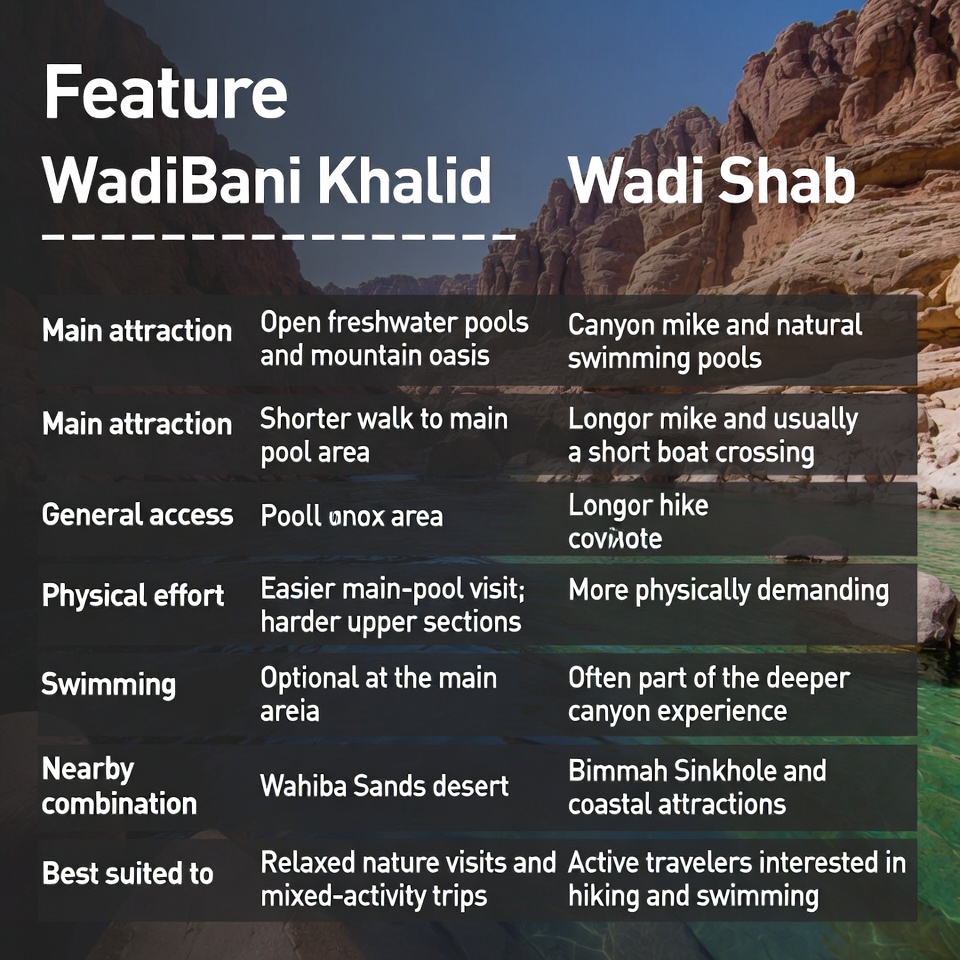
Choose Wadi Bani Khalid if you want attractive natural pools with relatively convenient access, especially as part of a desert excursion.
Choose Wadi Shab if you enjoy a more active hiking experience and are comfortable with the additional physical demands and swimming conditions.
Both should only be visited when weather and water conditions are safe.
If Wadi Shab sounds more like your ideal adventure, you can also explore Spring Tours Oman's Wadi Shab & Coastal Tour.
Is Wadi Bani Khalid Good for Families and Children?
Wadi Bani Khalid can be a rewarding family destination, particularly for those who enjoy outdoor scenery.
The relatively short approach to the main pools makes it more convenient than destinations that require long hikes.
Families can enjoy the views, take photographs, and relax together in the natural surroundings.
However, the wadi is still a natural environment rather than a managed swimming pool.
There can be uneven ground, slippery rock surfaces, deep water, and areas without barriers.
Parents should assess whether the conditions are suitable for their children and provide continuous supervision.
For families who prefer not to swim, a scenic visit can still be enjoyable.
Traveling with a local guide or organized tour may also help simplify the day's transportation and planning.
What Should You Wear and Bring to Wadi Bani Khalid?
You don't need a large amount of equipment for a standard visit, but a few essentials will make the day more comfortable.
Recommended packing checklist:
-Comfortable walking shoes with good grip
-Water shoes if you intend to enter permitted swimming areas
-Modest, quick-drying swimwear
-A towel and a change of clothes
-Drinking water
-Sunscreen and a sun hat
-Sunglasses
-A waterproof pouch for your phone
-A small bag for taking your rubbish away
-Any personal medication or essential supplies
If you're planning a longer walk, additional water and suitable outdoor equipment are important.
For cave exploration, ordinary sightseeing equipment may not be enough. Arrange appropriate guidance and equipment rather than entering an unfamiliar cave independently.
What About Entrance Fees, Parking and Facilities?
Visitors commonly use the main parking area near the natural pools.
Public access to the main pools has generally been reported as free, but a fixed official entrance-fee schedule and operating hours could not be independently confirmed for every visit date.
Charges for parking, facilities, private services, or guided activities may differ, and arrangements can change.
Some basic visitor facilities may be available around the principal pool area, but you should not depend entirely on on-site food or supplies.
Bring drinking water and anything essential for your visit.
It is also sensible to carry a small amount of cash for incidental purchases.
Because this is an outdoor natural attraction, plan your visit during daylight and confirm any local access restrictions before traveling.
Five Things Travelers Often Overlook Before Visiting
The Drive Is Part of the Day
Wadi Bani Khalid isn't a quick stop on the edge of Muscat.
Allow enough time for the round trip, particularly if you plan to swim, explore, or continue into the desert.
An early departure can make the experience more comfortable.
The Main Pool Isn't the Whole Valley
The most famous photographs show the accessible pools, but the surrounding mountain landscape is part of what makes the area special.
Even a short walk along an appropriate path can offer a different view.
Not Every Beautiful Pool Is Safe to Enter
Clear water can conceal slippery surfaces, deep sections, or underwater obstacles.
Treat swimming as optional and follow local guidance.
Desert Driving Is Different from Driving to the Wadi
A regular car may be suitable for reaching the main pool parking area, but driving into the sand dunes is another matter.
Do not take an unsuitable vehicle into the desert.
Weather Matters More Than the Calendar
A sunny morning does not automatically mean a wadi is safe.
Rain in upstream mountain areas can cause sudden flooding.
Monitor official warnings and postpone your trip if necessary.
How to Enjoy Wadi Bani Khalid Responsibly
Wadi Bani Khalid is not just a tourist attraction. It is part of a wider landscape that includes local communities, water sources, and traditional agricultural practices.
Respect for the area helps preserve the experience for everyone.
Take all rubbish with you, avoid using soap or detergents in natural pools, and do not damage vegetation or rock formations.
Dress appropriately for a public place in Oman, and ask permission before photographing local residents.
Avoid loud music or disruptive behavior, particularly near families and quieter areas.
If conditions are unsafe or access is restricted, respect the instructions of local authorities and site personnel.
Responsible travel is part of enjoying Oman's natural beauty.
Is Wadi Bani Khalid Worth Visiting?
Yes. Wadi Bani Khalid is worth visiting if you enjoy natural scenery, freshwater pools, easy-to-reach viewpoints, and the opportunity to experience Oman's mountain landscapes.
It is particularly appealing to travelers looking for a destination that offers more than ordinary sightseeing.
You can enjoy the landscape without swimming, spend time beside the pools, or include the destination in a broader adventure.
However, whether it deserves a full day depends on your itinerary.
If you only have a short time in Oman, combining the wadi with Wahiba Sands is often a more varied option than making a long round trip solely for the main pools.
And if you prefer strenuous canyon hiking, you may find Wadi Shab a better match for your interests.
The best choice is the one that matches your travel style.